Thursday, November 4, 2010

Another Bomb In Greece. Blamed On "Conspiracy of Fire Nuclei"

Greek authorities have destroyed another mail bomb. This one was returned to a delivery service by the French embassy according to the Associated Press. Police said the latest package contained a small amount of explosives and was destroyed by controlled explosion. They said an erroneous return address on the package was for the Greek Orthodox Church. A 48 hour ban on all international mail leaving Greece is still in effect. Two men have been arrested. Greek police say they are members of an anarchist group the "Conspiracy of Fire Nuclei."

Police released pictures of five men they are seeking in connection with the attacks, who they say are also members of the shadowy group. From the WSJ: Little is known about the Conspiracy of Fire Nuclei, which first emerged in early 2008, six years after Greek police dismantled the country's notorious left-wing November 17 terror group. The Conspiracy of Fire Nuclei has been known for nonlethal bomb attacks around Athens despite the arrests of several of its members—most of them in their 20s—in the past two years. The group is seen as anti-authoritarian and the most recent targets may reflect their opposition to Greece's fiscal austerity program after a European Union sponsored €110 billion ($154 billion) bailout package this year.

Read more...

Tuesday, November 2, 2010

Possibly harmful parcel at German leader's office

German police disarmed a potentially harmful package from Greece at German Chancellor Angela Merkel's office Tuesday, hours after similar small mail bombs exploded outside the Russian and Swiss embassies in Athens in attacks blamed on Greek far-left extremists. Greek police destroyed at least three more suspected bombs in Athens, and two local men have been charged with mailing bombs. Merkel's spokesman Steffen Seibert said the suspicious package intercepted in the mailroom of her office was personally addressed to the German chancellor and "would have been able to harm people."


German Interior Minister Thomas de Maiziere said the package, which arrived midday at the mailroom of the Chancellor Angela Merkel's office, was sent from Greece two days ago and resembled a series of small mail bombs in Athens. De Maiziere said that not only did the package have a Greek return address, but also authorities had been able to trace that it had been sent from Greece two days ago. "It contained an explosive device," de Maiziere told reporters. "Based on everything that we know, it was built in the same way and visually resembled the package that exploded at the Swiss embassy in Athens," he said.

Read more...

Sunday, October 31, 2010

Baghdad church hostage drama ends in bloodbath

At least 37 people have been killed after Iraqi security forces stormed a Catholic church in central Baghdad to free dozens of hostages being held by gunmen there, security sources say. Twenty-five hostages were among the dead, along with seven members of the Iraqi security forces and at least five of the attackers, they told the BBC. About 100 people had been inside Our Lady of Salvation for an evening Mass. The gunmen had reportedly demanded the release of jailed al-Qaeda militants.


The local TV station, al-Baghdadiya, said it had received a phone call from someone claiming to be one of the attackers, who said they were from the Islamic State of Iraq, a Sunni militant umbrella group to which al-Qaeda in Iraq belongs. Reports said the attackers were not Iraqis, but foreign Arabs. The raid came two days after a suicide attack on a cafe in Diyala province left 21 people dead. Security forces later surrounded the church and sealed off the area, with helicopters hovering overhead. Then they stormed the building.


Witnesses nearby said they then heard two explosions from inside the church and more shooting. One eyewitness, who was inside the church, was quoted by the AFP news agency as saying that the gunmen "came into the prayer hall and immediately killed the priest". The witness, who declined to give his name, said the people in the church had huddled into the main prayer hall when the gunbattles began with the security forces. The gunmen reportedly threw grenades and blew their suicide vests. There were no negotiations with the gunmen before the security forces stormed the church.

Read more...

Wednesday, October 27, 2010

Over $3 Billion in Fraud Recoveries Under the False Claims Act in FY 2010

Taxpayers Against Fraud calculates the U.S. Department of Justice recovered over $3.1 billion of America's stolen money in Fiscal Year 2010 thanks to whistleblowers and the federal False Claims Act. More than 80 percent of all successful False Claims Act recoveries are brought to the government by whistleblowers and their lawyers, making the law the most important tool the U.S. Government has in the war against fraud. The False Claims Act provides for triple damages plus statutory fines of up to $11,000 per false claim. Whistleblowers that bring evidence of fraud to the U.S. Government are eligible for awards of 15 to 30 percent of the total amount recovered under the Act.


Read more...

Monday, October 25, 2010

Fighting fraud the Canadian Way

Surfing the web is like swimming with sharks. There are scam artists lurking in every shadow, flooding inboxes with bogus requests, phishing for bank account numbers and other personal data. While the fraudsters operate from keyboards in locations around the globe, the Canadian crime fighters trying to shut them down are tucked away in a small office in North Bay. The Canadian Anti-Fraud Call Centre, in the Ministry of Correctional Services building on First Avenue, is the country's hub for collecting information and criminal intelligence on everything from telemarketing and Internet fraud to identity theft. Jointly managed by the Royal Canadian Mounted Police, Ontario Provincial Police and Competition Bureau of Canada, the anti-fraud centre deals with reports involving Canadian content from victims across North America.

But fighting the onslaught is a momentous task that can only be won through public education. That is the No. 1 way to combat this type of fraud," said RCMP Staff Sgt. Paul Proulx, who oversees the operation. The more people who know about fraud, the more they can recognize it." A staff of 24 includes operators who receive complaints and specialists who analyze the information. The centre's role, however, is not to send officers out into the field to make arrests, but rather to identify possible fraud operations and notify the appropriate law enforcement agency. RCMP Cpl. Louis Robertson, who heads up the criminal intelligence unit, has cultivated relationships with agencies around the world, including the Federal Bureau of Investigation in the United States, which is under no obligation to co-operate.

Although fraud operations do get shut down as a result of the centre's work, they are often only temporary disruptions." That's why public awareness is such an important weapon. In fact, the centre is planning to launch a public education campaign early next month, complete with a new website at antifraudcentre.ca. The centre receives about 500 e-mails per day from people reporting possible fraud and some 10,000 phone calls each month. And the numbers are growing. Formerly called Project PhoneBusters, the centre was created in 1993 by OPP officer Barry Elliott. At that time, the focus was mainly on telemarketing fraud. But, as Internet technology advanced, the centre evolved along with the scope of the crimes.

Read more...

Saturday, October 23, 2010

Central hub for Texas police info opens up

Think of it as a central hub allowing law enforcement from across the Lone Star State to fight terror. That's what the new Texas Department of Public Safety Fusion Center will be, and a ribbon-cutting ceremony Thursday morning for the new facility got officials of various agencies a step closer to a useful tool in the fight against crime. The idea is to pool intelligence to help prevent terrorist attacks and track organized crime, the like Mexican cartel drug activity. "Every agency has expertise and intelligence analysis. They also have information," said DPS Director Steve McCraw. "By combining that information is the only way you can get an accurate understanding of that threat environment."

Still, critics have called the center a threat to privacy, much like civil liberties groups have protested loudly about the Austin Regional Intelligence Center. The Austin City Council approved using a $150,000 federal grant in August 2009 to run the fusion center, which will allow 10 local law enforcement agencies to share crime information. Critics have said they are worried the information-sharing by law enforcement could lead to personal profiling and undue surveillance. Yet, law enforcement agencies in Travis, Hays and Williamson counties said the goal of the center is to fight organized crime and to track crime trends.

Read more...

Thursday, October 21, 2010

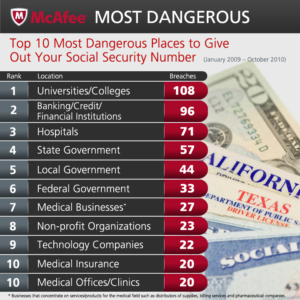
Top Ten Most Dangerous Places to Leave Your Social Security Number

Cases of identity theft are skyrocketing, and 32% of all ID theft victims had their social security number compromised according to Javelin's 2010 Identity Fraud Survey Report. In honor of National Identity Protection week, McAfee set out to reveal the most dangerous places to leave your social security number. When your Social Security number is used to commit fraud, it feels very personal. It can take hundreds of hours and sometimes thousands of dollars to rectify this violation.


Criminals find these crucial nine digits on discarded files in dumpsters, inside an organizations' file cabinets, in any of the hundreds of databases maintained by government, corporate, and educational institutions, or even in public records, which are freely accessible on the Internet. Robert Siciliano, on behalf of McAfee, analyzed data breaches published by the Identity Theft Resource Center, Privacy Rights Clearinghouse and the Open Security Foundation that involved Social Security number breaches from January 2009 - October 2010 to reveal the riskiest places to lose your ID.


Read more...

Firm scammed US by using dementia patients

Federal authorities charged the nation's largest chain of community mental health centers Thursday with Medicare fraud, alleging the Miami-based company preyed on patients with severe dementia to bill $200 million for services it never delivered. Prosecutors allege that American Therapeutic Corp. and its sister companies faked medication and care charts and paid the owners of assisted living facilities and halfway houses to bring patients to their seven mental health centers in south and central Florida for therapy sessions that were never held.


Some patients also cashed in on the scheme by providing their Medicare numbers, while others were "not coherent enough" to demand kickbacks, according to the investigation by the departments of Justice and Health and Human Services. The alleged scam is "unlike anything we've seen before in terms of the nature and size of the scheme," said Assistant Attorney General Lanny Breuer.


Federal authorities arrested four of the company's owners and top managers Thursday and served search warrants at several of the centers. The grand jury indictment alleges that ATC routinely billed Medicare for therapy and other services for patients suffering from Alzheimer's and severe dementia even though they weren't eligible because their mental capacity was so impaired they couldn't benefit from therapy.

Read more...

Wednesday, October 20, 2010

ICE arrests 20 criminals in international INTERPOL operation

U.S. Immigration and Customs Enforcement (ICE) Director John Morton and INTERPOL Washington Director Timothy A. Williams announced that the first-ever joint operation, called "Operation FAR AWAY," has been very successful, resulting in a total of 20 arrests of international fugitives in the United States.

"Operation FAR AWAY" is an intelligence-driven operation designed to target, locate and arrest criminal aliens believed to be in hiding in the United States and in other Western Hemisphere countries. It began Sept. 1 and will extend until Oct. 31, 2010, due to the high number of arrests. The INTERPOL member countries participating in the operation include: Canada, Honduras, El Salvador, Mexico, Costa Rica, Bahamas, Netherland Antilles, Brazil, Guatemala, Peru, Colombia, Barbados, Bolivia, Ecuador and the United States. Of the 20 arrests made in the United States, eight of them were for homicide crimes; two were for crimes against children; three were for robbery; and seven were for other crimes, including human smuggling. Arrests in the United States were made by the ICE Office of Enforcement and Removal Operations (ERO).

"This operation has been so successful, with the help of our INTERPOL partners, that we have decided to extend it," said Jim Chaparro, ICE Executive Associate Director of ERO. "Operation FAR AWAY enhances public safety in the United States and with our partner nations."

"I am very pleased with the outcome of the operation to date. It is another fine example of what can be accomplished when agencies partner and share resources to further combat transnational crimes," stated Timothy A. Williams, INTERPOL Washington Director. "I look forward to continuing the high level of cooperation and collaboration with ICE ERO, and I extend my gratitude to the leadership at ICE ERO for providing appropriate resources to ensure this operation is a success."

Read more...

Price adds to growing popularity of heroin

Staggering figures about heroin show it is quickly becoming the drug of choice among some high school students. From Seattle to Salt Lake County, it appears the availability of stronger and cheaper heroin is a driving factor. Police in the Seattle area say a bag of heroin can cost as little as $5.00. In Utah, that would make heroin cheaper than marijuana and spice. Unified police tell KSL marijuana and spice each sell for $10 to $50 for an eighth of an ounce, depending on the quality.


It's being called an epidemic in the Seattle area. KING 5 News reports 42 students between the ages of 15 and 17 in Stanwood, Wash., are reportedly receiving treatment or are being admitted for the treatment of heroin addiction. One addict points out the painkiller OxyContin costs $60 for a pill while heroin costs only $5.00. Another problem with heroin is the potency. Police in Utah have said in recent months they occasionally see heroin that is 80 to 90 percent pure, rather than 30 to 40 percent pure.

Read more...

Followers

Search This Blog

Who am I?

I am a law enforcement professional with over 35 years experience in both sworn and civilian positions. I have service in 3 different countries in both the northern and southern hemispheres.

My principal areas of expertise are: (1) Intelligence, (2) Training and Development, (3) Knowledge Management, and (4) Administration/Supervision.

  © Blogger templates The Professional Template by Ourblogtemplates.com 2008

Back to TOP