Association of Law Enforcement Intelligence Units (LEIU) / International Association of Law Enforcement Intelligence Analysts (IALEIA) Annual Conference
April 30 - May 4, 2012 at the Loews Coronado Bay on Coronado Island (San Diego), California.
Building upon the success of our First International Symposium held earlier this year in Vancouver, Canada, the IACA will once again offer a training symposium. In 2012, the IACA will partner with Europol for the Second International Symposium.
The 2012 Symposium will be held April 17th - 18th, 2012 at the Headquarters of Europol in The Hague, the Netherlands.
Registration for the Second International Symposium will open in January and the annual training conference registration will open in February. More information about these unique training events will be posted soon. Keep up-to-date by following us on Twitter, Facebook, LinkedIn, our Blog, or right here on iaca.net. You can also follow @IACAConference on Twitter to receive only conference-related news and updates.
TheIACA 22nd Annual Training Conference will be held at The Ravella, a luxury resort in Henderson, Nevada. The conference dates are September 10th - 13th, 2012. A Mediterranean-inspired oasis nestled in the Southwestern desert, The Ravella infuses a dramatic setting with unimaginable luxury and amenities.
In addition to its scenic location, the 2012 conference will feature many training sessions for analysts at all experience levels. A combination of great training, picturesque location and excellent facilities makes this a unique training conference experience that you will not want to miss!
PHOENIX » The tagline on Shawna Forde's anti-illegal immigration Web site says her group was "doing the job our government won't do." They wanted to patrol the border, but her small band of activists needed money to do it.
So, authorities say, Forde and two men dressed up as Border Patrol agents and broke into the southern Arizona home of a man they thought was a drug dealer, hunting for money or drugs to sell. They found neither, but killed the man and his 9-year-old daughter.
The May 30 killings rocked an anti-illegal immigration movement that prides itself on being vocal but not violent, and added to a growing list of activists unafraid of using violence to advance their aims.
In recent months, several high-profile incidents have raised awareness of the threat posed by individuals and small groups operating under the principles of leaderless resistance. These incidents have included lone wolf attacks against a doctor who performed abortions in Kansas, an armed forces recruitment center in Arkansas and the U.S. Holocaust Memorial Museum in Washington, D.C. Additionally, a grassroots jihadist cell was arrested for attempting to bomb Jewish targets in the Bronx and planning to shoot down a military aircraft at an Air National Guard base in Newburgh, N.Y.
In addition to pointing out the threat posed by grassroots cells and lone wolf operatives, another common factor in all of these incidents is the threat of violence to houses of worship. The cell arrested in New York left what they thought to be active improvised explosive devices outside the Riverdale Temple and the Riverdale Jewish Community Center. Dr. George Tiller was shot and killed in the lobby of the Reformation Lutheran Church in Wichita. Although Abdulhakim Mujahid Muhammad conducted his attack against a Little Rock recruiting center, he had conducted preoperational surveillance and research on targets that included Jewish organizations and a Baptist church in places as far away as Atlanta and Philadelphia. And while James von Brunn attacked the Holocaust Museum, he had a list of other potential targets in his vehicle that included the National Cathedral.
In light of this common thread, it might be instructive to take a more detailed look at the issue of providing security for places of worship.
Open source information means data obtained from public sources.It is extracted from newspapers, journals, radio and television, and the Internet. Intelligence analysts have long used such information to supplement classified data, but systematically collecting open source information has not traditionally been a priority. However, in recent years, given changes in the international environment, there have been calls, from Congress and the 9/11 Commission for instance, asking for a more intense and focused investment in open source collection and analysis. Many, however still emphasize that the primary business of intelligence continues to be obtaining and analyzing secrets. A consensus now exists that OSINT must be systematically collected and should constitute an essential component of analytical products.
For 40 years, U.S. presidents have begun each day with a top-secret, personal briefing on security threats and global affairs obtained largely from covert spy missions, clandestine satellite surveillance and other highly classified intelligence sources. Now, however, the President's Daily Brief and other crucial intelligence reports often rely less on secrets from risky espionage missions than on material that's available to just about anyone. Intelligence officers have gleaned insights on Iran's nuclear capabilities from photos on the Internet. They've scooped up documents, including a terrorist training manual, at international conferences and public forums. They've found information in foreign university libraries and newscasts.
While open source intelligence may come from unclassified material that's available to anyone with a television or an internet connection. Michael Hayden, CIA chief under President George W. Bush, believes even finished products created from OSINT must be kept out of public view as it's just too sensitive for average people to see. The information may be unclassified, but official interest in it is not!
In the information Age, that enjoys a proliferation of publicly available information, it seems ironic that in many places it still is considered a poor cousin. Even more so when you consider that some analysts in law enforcement and the intelligence community undervalue open source information precisely because it is so readily available.
Nobody tasked with intelligence in the field of public safety should ignore open sources. Open source material not only fills in blanks about often-elusive adversaries; it can also give a broader sense of the mood in a particular country, or the feeling in a particular group. Open Source information should be appropriately and regularly collected to meet agency needs and lead and direct all police operations.
In our new era, everyone, including terrorists, may use open sources of information that are equal or superior to secret sources. The new craft of intelligence requires all the players to function as part of a team, and asks them to win however they can. It uses the collective wisdom of all the participants. It encourages the crowd to participate. Open source intelligence harnesses what everyone sees and knows. It changes the rules of the game.
Links for further information on Open Source Information/Intelligence:
One result of the changes in our society is that today’s criminals are displaying increased sophistication and operational agility in their efforts to subvert law and order. This in turn has created a need for law enforcement agencies – at all levels – to concentrate their collective efforts in a more structured manner and to modernize the various business processes they use to determine resource allocations. Experience suggests that the optimum way to achieve these goals is through a new series of processes and procedures called Intelligence-Led Policing. Intelligence-led policing is an extremely useful way of thinking about law enforcement and delivery of police services. ILP is all about providing decision-makers at any level of a law enforcement organization with the intelligence and analysis upon which to base good decisions.
Intelligence-led policing is both a business model and managerial philosophy. Crime analysis and criminal intelligence are the foundations to an objective, decision-making framework that facilitates crime and problem reduction, disruption and prevention through both strategic management and effective enforcement strategies that target prolific and serious offenders.
Intelligence-led policing was originally thought of as a law enforcement strategy seeking to reduce crime through the combined use of crime analysis and criminal intelligence. The purpose was to determine appropriate crime reduction tactics that concentrate on the prevention and enforcement of criminal offender activity, with a focus on active recidivists.
This approach emphasized information gathering through the extensive use of confidential informants, offender interviews, analysis of recorded crime and calls for service, surveillance of suspects, and community sources of information. These sources were analyzed so that law enforcement managers could determine objective policing tactics in regard to enforcement targets, prevention activities and further intelligence gathering operations.
In the last few years, the interpretation of 'intelligence-led policing' appears to be broadening in scope. While still retaining the central notion that police should avoid getting bogged down in reactive, individual, case investigations, intelligence-led policing is evolving into a management philosophy that places greater emphasis on information-sharing and collaborative, strategic solutions to crime problems at the local and regional level.
Originating in the United Kingdom, intelligence-led policing began with the idea that police were spending too much time responding to crime and too little time targeting offenders. Audit reports encouraged increased use of intelligence, surveillance and informants to target recidivist offenders so that police could be more effective in fighting crime. Since then, ILP and its practice has extended to Australia, New Zealand, Europe, and since September 11th, 2001, the United States.
However, ILP will never reach its true potential unless all police, law enforcement and public safety leaders catch the vision of this important paradigm. Intelligence-led policing is a model that has gained significant acceptance in the United States since 9/11. There is a good reason for this: no other single approach can offer the same protection in the current worldwide environment of crime, terrorism and the explosion of information. More importantly, in its wider application ILP works well with other models and enhances them by providing a foundation of analysis. Whatever policing approach that is adopted locally, ILP can make it work better. It does so by providing the intelligence and information on which to more accurately base decisions about any given problem or situation.
Links for further information on Intelligence-led Policing:
“Never interrupt your enemy when he is making a mistake.” Napoleon Bonaparte 1769-1821 French military and political leader, Emperor
Intelligence Environment
"In order to achieve results we need a law enforcement environment that views intelligence as a precondition to effective policing, rather than as a supplement."
Robert Kopal
Intelligence-led Policing (ILP)
"Executive implementation of the Intelligence Cycle to support proactive decision making for resource allocation and crime prevention."
IALEIA
"Intelligence-led policing is a business model and managerial philosophy where data analysis and crime intelligence are pivotal to an objective, decision-making framework that facilitates crime and problem reduction, disruption and prevention through both strategic management and effective enforcement strategies that target prolific and serious offenders."
Dr. Jerry H. Ratcliffe
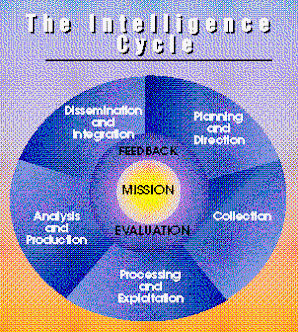
Intelligence Cycle
The intelligence cycle is the process of developing unrefined data into polished intelligence for the use of policymakers. FBI
Criminal Intelligence
"Intelligence within the law enforcement context, whether of a tactical or strategic nature, refers to the collection, collation, evaluation, analysis, and dissemination for use of information relating to criminal or suspected criminal activities of a wide variety."
IACP
Criminal Intelligence Analysis
"The identification of and provision of insight into the relationship between crime data and other potentially relevant data with a view to police and judicial practice."
Europol
Crime Analysis
"Crime analysis is the study of criminal incidents; the identification of patterns, trends, and problems; and the dissemination of information that helps a police agency develop tactics and strategies to solve patterns, trends, and problems."
I am a law enforcement professional with over 35 years experience in both sworn and civilian positions. I have service in 3 different countries in both the northern and southern hemispheres.
My principal areas of expertise are: (1) Intelligence, (2) Training and Development, (3) Knowledge Management, and (4) Administration/Supervision.